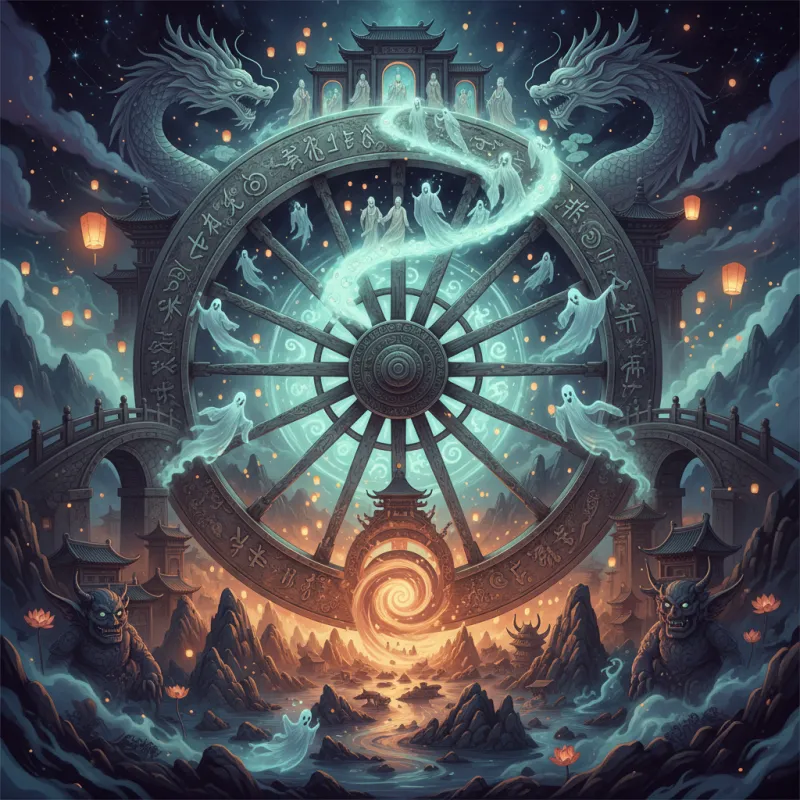
Your grandmother dies at 3 AM on a Tuesday. By 3:15 AM, her 魂 (hún, ethereal soul) is already standing in line at the first of ten bureaucratic checkpoints in the Chinese underworld, clutching a number like she's waiting at the DMV. Except this DMV determines whether she spends the next few centuries as a human, a dog, or something considerably worse.
This is 轮回 (lúnhuí) — the Wheel of Reincarnation — and it operates with the cold efficiency of a factory assembly line. Death is not an ending in Chinese cosmology. It's a mandatory recycling program for souls.
The Mechanics of Soul Recycling
When you die, your 魂 (hún) separates from your 魄 (pò, corporeal soul) and enters 阴间 (yīnjiān, the underworld). The pò stays with your corpse and eventually dissolves. The hún — your consciousness, memories, personality — gets processed.
The system emerged from a collision between Buddhist karma theory (imported during the Han Dynasty, around 1st century CE) and indigenous Chinese ancestor worship. Buddhists brought the concept of rebirth based on moral conduct. The Chinese added what they do best: bureaucracy and record-keeping.
The result? A afterlife that functions like a cosmic sorting facility. Your soul enters at one end, gets evaluated across multiple departments, receives appropriate punishment or reward, and exits at the other end in a new body. The entire process can take anywhere from days to centuries, depending on how badly you screwed up during your previous life.
The Ten Courts of Hell: Your Soul's Performance Review
Before reincarnation, every soul faces judgment in the Ten Courts of Hell. Each court, presided over by a different 阎王 (Yánwáng, King of Hell), examines specific categories of sin.
First Court: 秦广王 (Qín Guǎng Wáng) reviews your overall moral record. Think of him as the intake officer who determines which subsequent courts you'll visit.
Second through Ninth Courts: Specialized departments. The Second Court handles corruption and medical malpractice. The Third Court punishes ingratitude and disrespect toward elders. The Fifth Court — run by 阎罗王 (Yánluó Wáng), the most famous King of Hell — deals with murder and violent crimes. Each court has its own torture chambers with punishments that match the crime with poetic precision. Liars get their tongues ripped out. Thieves have their hands crushed. Adulterers are thrown into pools of blood.
The punishments aren't eternal. They're corrective. You serve your sentence, learn your lesson (theoretically), and move forward in the process.
Tenth Court: 转轮王 (Zhuǎnlún Wáng), the King of the Revolving Wheel, makes the final determination. Based on your accumulated karma — good deeds minus bad deeds, adjusted for sincerity and circumstance — he assigns your next incarnation.
The Six Realms: Where You Might End Up
The Wheel of Reincarnation has six possible destinations, arranged in a hierarchy from best to worst:
天道 (tiān dào, Realm of Heaven): Reserved for souls with exceptional merit. You become a celestial being or deity. Comfortable, but not permanent — even gods eventually exhaust their good karma and get recycled.
人道 (rén dào, Realm of Humans): The sweet spot. Being reborn as a human gives you the best opportunity to accumulate merit and potentially escape the wheel entirely. You have moral agency, access to Buddhist and Daoist teachings, and the cognitive capacity to practice cultivation.
阿修罗道 (āxiūluó dào, Realm of Asuras): Warrior spirits. Powerful but perpetually angry and engaged in pointless conflicts. Think of them as the road-rage drivers of the afterlife.
畜生道 (chùshēng dào, Realm of Animals): Self-explanatory. You come back as a dog, pig, insect, or any other creature. Duration varies based on the severity of your karmic debt.
饿鬼道 (è guǐ dào, Realm of Hungry Ghosts): Reserved for the greedy and gluttonous. You become a hungry ghost with an enormous belly and a throat the width of a needle. Perpetually starving, unable to satisfy your hunger.
地狱道 (dìyù dào, Realm of Hell): The bottom tier. For truly heinous crimes — patricide, matricide, killing Buddhist monks — you're sent to specialized hell realms for extended torture before being allowed back into the reincarnation cycle.
Meng Po's Soup: The Memory Wipe
After your assignment is determined, you encounter 孟婆 (Mèng Pó), an old woman who operates a tea stand at the exit of the underworld. She serves you 孟婆汤 (Mèng Pó tāng, Meng Po's Soup) — a brew made from herbs gathered from the mortal world, designed to erase all memories of your previous lives.
This is not optional. You drink the soup. You forget everything. Your past life, your family, your accomplishments, your failures — all gone. Then you're pushed across the 奈何桥 (Nàihé Qiáo, Bridge of Helplessness) and into your new incarnation.
The memory wipe serves a practical purpose. Imagine being reborn as a pig while retaining full memory of your previous life as a scholar. The psychological torment would be unbearable. Meng Po's soup is a mercy, even if it doesn't feel like one.
Some souls try to resist. They spit out the soup, or only pretend to drink it. According to folklore, these souls are reborn with fragmented memories — the source of déjà vu, childhood prodigies who seem to possess knowledge beyond their years, and people who claim to remember past lives.
Breaking the Wheel: Escape Routes
The entire system is designed to be cyclical, but it's not inescapable. Chinese religious traditions offer several methods to exit the Wheel of Reincarnation permanently:
Buddhist Path: Achieve enlightenment through meditation, moral conduct, and understanding the nature of suffering. Become an 阿罗汉 (āluóhàn, arhat) or 菩萨 (púsà, bodhisattva) and transcend the cycle entirely.
Daoist Path: Cultivate your 精气神 (jīng qì shén, essence, energy, and spirit) through alchemical practices, meditation, and moral living. Become an 仙 (xiān, immortal) and ascend to the celestial realms without needing to die and reincarnate.
Pure Land Path: Accumulate enough merit and devotion to 阿弥陀佛 (Āmítuó Fó, Amitabha Buddha) that upon death, you're transported directly to the Western Pure Land — a paradise outside the reincarnation system where you can practice Buddhism under ideal conditions until you achieve enlightenment.
The catch? All of these require extraordinary discipline, moral purity, and often multiple lifetimes of effort. Most souls don't make it. They accumulate some good karma, some bad karma, and get recycled again and again.
The Wheel in Chinese Literature and Folk Religion
The Wheel of Reincarnation appears constantly in Chinese supernatural fiction. In Journey to the West (西游记, Xī Yóu Jì), written during the Ming Dynasty, several characters are revealed to be reincarnations of celestial beings who were punished and sent through the wheel. 猪八戒 (Zhū Bājiè, Pigsy) was originally a heavenly marshal who got drunk and harassed a goddess — he was reincarnated as a pig-demon as punishment.
Strange Tales from a Chinese Studio (聊斋志异, Liáozhāi Zhìyì) by Pu Songling includes dozens of stories about souls navigating the underworld bureaucracy, negotiating with judges, and attempting to secure better reincarnations through bribes or appeals.
In contemporary folk religion, the Wheel remains central to funeral practices. Families burn paper money, paper houses, and paper servants to ensure their deceased relatives have resources in the underworld. They hire Buddhist monks or Daoist priests to perform rituals that reduce the deceased's karmic debt and improve their chances of a favorable reincarnation.
During 清明节 (Qīngmíng Jié, Tomb Sweeping Day) and 中元节 (Zhōngyuán Jié, Ghost Festival), families make offerings to ancestors who are assumed to be somewhere in the reincarnation cycle — either still in the underworld awaiting judgment, or already reborn but spiritually connected to their descendants.
Why the Wheel Persists in Modern Chinese Thought
The Wheel of Reincarnation offers something that linear afterlife models (heaven/hell, eternal reward/punishment) don't: hope and accountability in equal measure.
Screwed up this life? You get another chance. Born into poverty or suffering? It's temporary — your next incarnation might be better if you accumulate merit now. Committed terrible acts? You'll face consequences, but not eternal damnation. The system is harsh but ultimately fair, operating on cosmic mathematics rather than divine whim.
This appeals to the Chinese philosophical preference for balance and cyclical thinking. The Wheel fits naturally into a worldview that sees all things — seasons, dynasties, personal fortunes — as moving in cycles rather than linear progressions.
It also provides a framework for moral behavior that doesn't require belief in a personal god. You don't need to fear divine judgment; you need to fear the natural consequences of your actions playing out across multiple lifetimes. Karma is presented not as supernatural punishment but as cosmic cause-and-effect.
Even among modern Chinese people who don't literally believe in reincarnation, the concept influences ethical thinking. The idea that your actions have consequences beyond your immediate lifetime, that you're part of a larger cosmic system of balance and reciprocity — these notions persist even when the literal belief in the Wheel fades.
The Wheel of Reincarnation is less a religious doctrine and more a comprehensive moral operating system. It answers the fundamental questions: Why do bad things happen to good people? What happens after death? How should I live? And it answers them with a system so elaborate, so bureaucratically detailed, that it feels almost plausible. Your soul isn't judged by a single deity in a single moment. It's processed through multiple departments, evaluated by specialists, given proportional consequences, and sent back into the world with a clean slate.
Whether you believe in it literally or treat it as metaphor, the Wheel offers the same message: your actions matter, death is not the end, and the universe keeps meticulous records.
Related Reading
- Hungry Ghosts and Wandering Souls: The Unquiet Dead of Chinese Folklore
- Diyu: The Chinese Underworld and Its Ten Courts of Hell
- Exploring the Mystical Realm of Chinese Ghosts and Afterlife Beliefs
- Exploring Chinese Beliefs in the Afterlife: Ghosts, Spirits, and Folklore
- The Hungry Ghost Festival: When the Gates of Hell Open
- Chinese Ghost Stories for Beginners: Where to Start
- Jiangshi: The Chinese Hopping Vampire
- The Shapeshifters of Chinese Folklore: Fox Spirits, Snake Demons, and Beyond
Explore Chinese Culture
- Explore ancient mythical creatures
- Explore Daoist exorcism traditions
- Explore Chinese folk beliefs and superstitions